
Espresso Grind Size Explained (and How to Dial It In)
 By Marco R. · Lead repair technician Updated June 18, 2026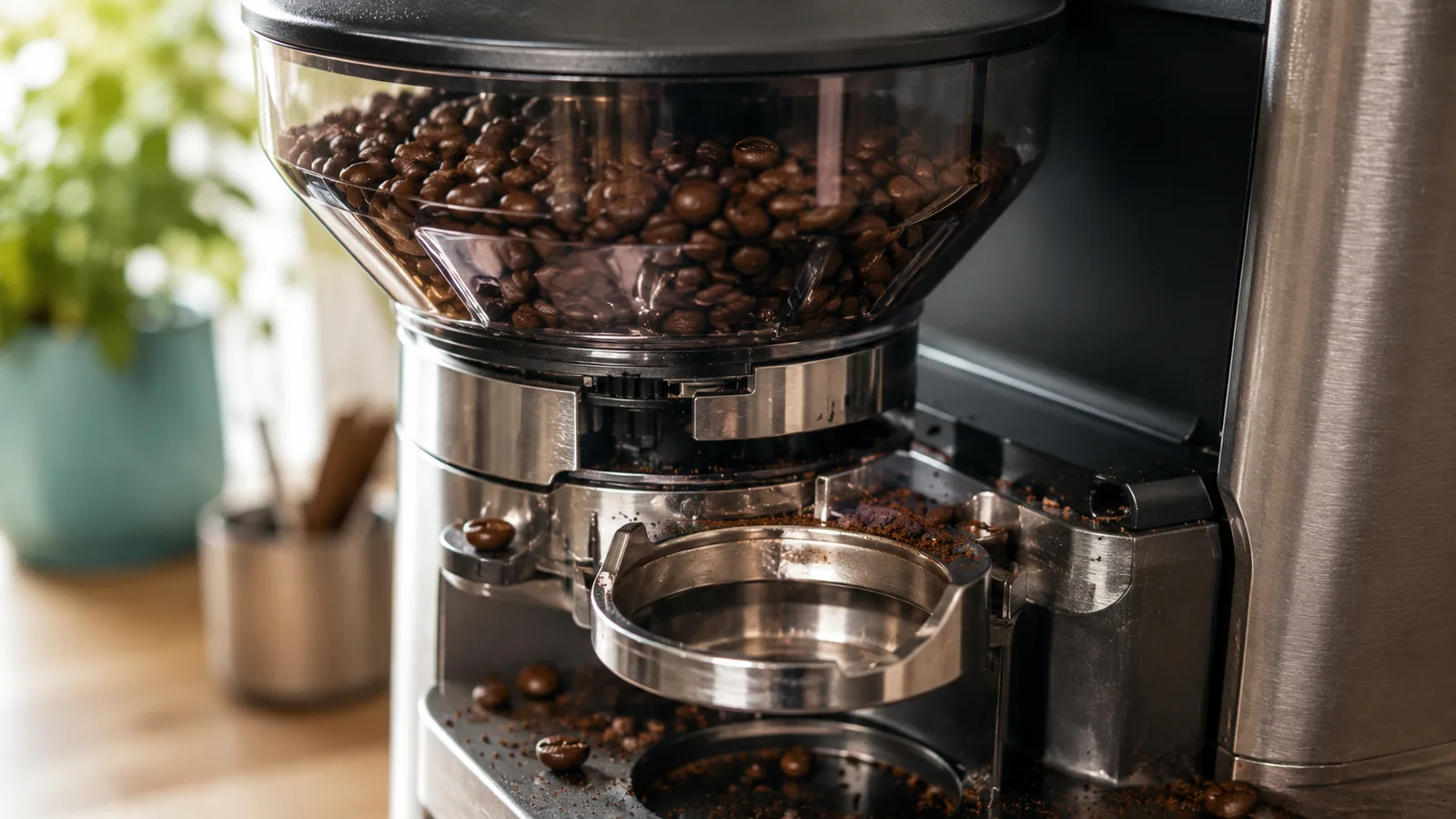
If you fix one thing about your espresso, fix the grind. It’s the single biggest lever on how a shot pours and tastes — bigger than the machine, the beans or the tamp. Most “my machine has no pressure” or “my coffee tastes bad” complaints aren’t machine faults at all; they’re a grind that’s too coarse or too fine. Understand grind, and you can dial in almost any machine; ignore it, and even a great machine makes bad coffee.
Why grind controls everything
Espresso works by forcing pressurised water through a packed bed of coffee. Grind size sets how hard that water has to push:
- Coarser grind = bigger gaps = less resistance = water rushes through → fast, pale, weak, sour shots.
- Finer grind = tighter bed = more resistance = water struggles through → slow, dark, bitter shots (or a choke).
Your job is to find the grind that gives the water just the right resistance — not too easy, not too hard. Everything else (dose, tamp, temperature) fine-tunes around it.
The target: time your shot
Forget chasing a magic number on the dial. Dial toward a result:
A double shot of about 2 oz (60 ml) in 25–30 seconds, from when the pump starts (after any pre-infusion).
| Shot behaviour | What it means | Do this |
|---|---|---|
| Gushes in under 20 s, pale | Too coarse / under-dosed | Grind finer |
| 25–30 s, honey-like pour | Dialled in | Leave it |
| Slow drip / chokes, dark | Too fine / over-dosed | Grind coarser |
How to dial in, step by step
- Start fine — espresso grind feels like fine sand, finer than table salt.
- Dose to fill the basket (commonly ~16–20 g for a double, depending on the basket).
- Distribute level and tamp flat with consistent pressure. Don’t tap the portafilter after tamping — it cracks the puck.
- Pull and time the shot.
- Adjust grind one step toward the 25–30 second target and pull again.
- Once the time is right, taste and nudge: a touch finer for more body, coarser if it’s harsh.
The grinder matters as much as the setting
A grind is only as good as the grinder that made it:
- Burr grinders crush beans to a uniform size, so the puck extracts evenly. Essential for espresso.
- Blade grinders chop unevenly into dust and chunks — the dust over-extracts (bitter) while chunks under-extract (sour), and the puck channels. Not suitable for espresso.
A consistent burr grinder — built into the machine or separate — is the most worthwhile espresso upgrade there is. If your shots are erratic no matter what you do, the grinder is often why.
Pressurised vs single-wall baskets
Your basket changes how forgiving the grind is:
- Pressurised (dual-wall) baskets create crema through a tiny valve, so they tolerate a coarse or pre-ground coffee — great for beginners (common on the De’Longhi Dedica, entry machines).
- Single-wall (commercial) baskets demand a genuinely fine, fresh, consistent grind, but reward you with better espresso.
Chasing “pressure” with a single-wall basket and a coarse grind is one of the most common mismatches we see.
Channeling: the silent shot-killer
Even a perfect grind pours badly if water carves a channel through the puck and skips the rest. Prevent it by distributing the grounds level before tamping and tamping flat — and never tapping the portafilter after the tamp. A squirty, uneven, side-spraying shot is usually channeling, not the machine.
Common mistakes
- Grinding coarser to “let more through” when a shot is weak — that’s backwards; weak shots need a finer grind.
- Changing several variables at once, so you can’t tell what helped.
- Using a blade grinder or stale pre-ground and blaming the machine.
- Tapping the portafilter after tamping, causing channeling.
- Expecting one setting to last forever — re-dial when you change beans.
Where to go next
Grind is the foundation; taste is the payoff. If your shots are dialled for time but still taste off, read why your espresso tastes bad. To see how grind fits the bigger picture, see how an espresso machine works — and if the grinder itself is misbehaving, the grinder problems guide covers jams and feeding issues.
Free: the Espresso Fix-It Cheat Sheet (PDF)
The 1-page printable that takes any fault to its cause, plus the maintenance schedule that prevents most breakdowns. Straight to your inbox.
By subscribing you agree to receive emails from BaristaFix and to our Privacy Policy. No spam — unsubscribe anytime.Frequently asked questions
What grind size should I use for espresso?
Why does my espresso pour too fast and taste weak or sour?
Why does my espresso drip slowly or choke and taste bitter?
How do I dial in espresso grind step by step?
Does the grinder matter, or just the setting?
Why do I have to keep changing my grind setting?
Marco spent twelve years servicing espresso machines — first behind the bench at a specialty café group, then running his own repair workshop. He has stripped down, fixed and reassembled everything from a battered Gaggia Classic to high-end Swiss automatics. He writes the fixes here only after reproducing the fault on a real machine, and he'll always tell you when a repair isn't worth the money.