
Breville Barista Express Leaking Water? Find Where It's Coming From and Stop It
 By Marco R. · Lead repair technician Updated June 17, 2026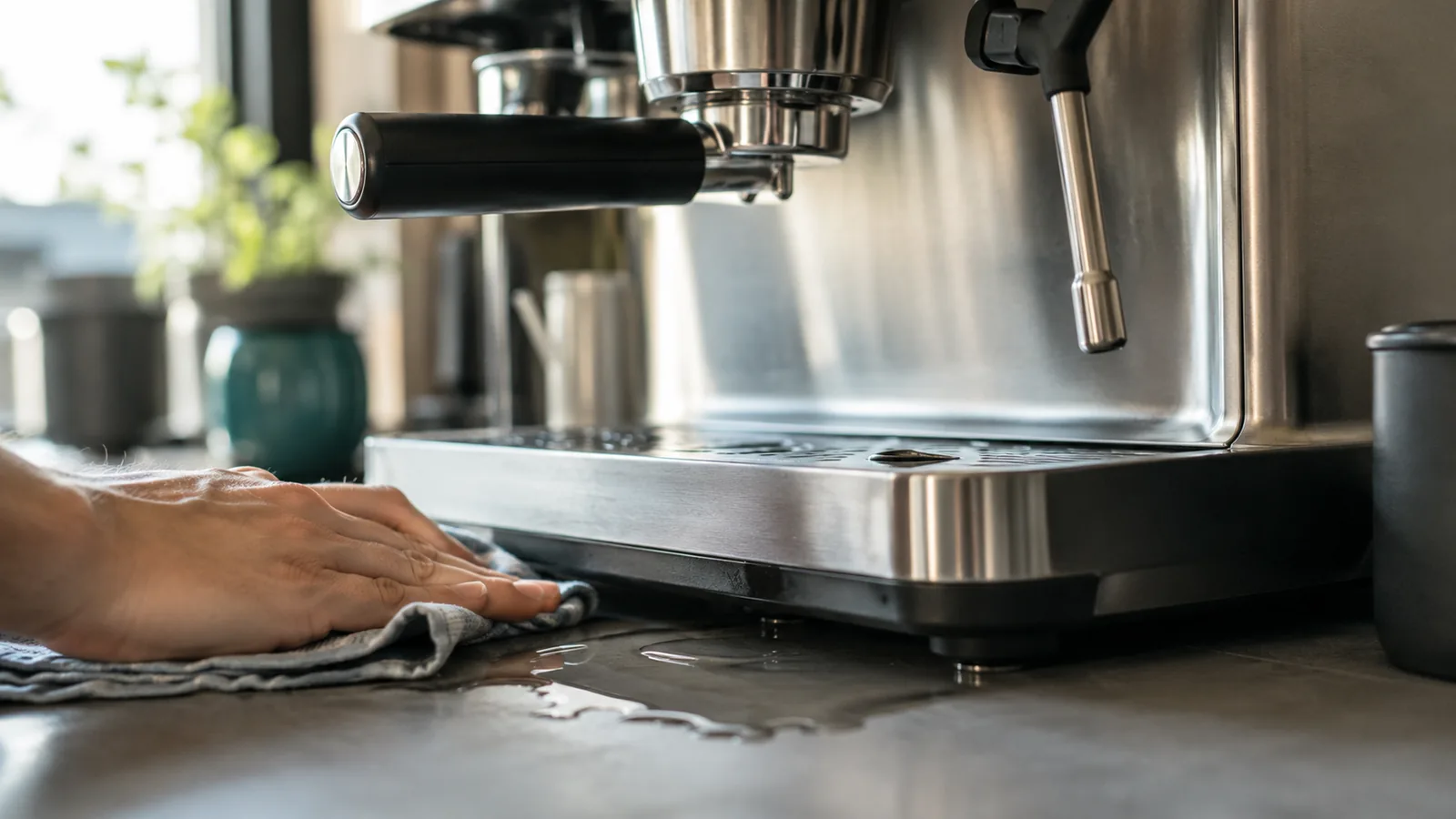
A puddle around an espresso machine sets off alarm bells, but “leaking” covers everything from a tank that’s a millimetre out of place to a perished seal deep inside. The trick is to stop guessing and find out where the water actually appears — because each location points to a different, usually cheap, fix.
Grab a dry cloth, pull a shot, and watch closely. Where the first water shows up is your diagnosis.
First, locate the leak
- Front, around the portafilter, during a shot: the group head gasket. Go to Cause 3.
- Back, near the tank: tank seating, overfill or a cracked tank. Cause 1.
- Underneath, pooling on the counter: drip tray overflow first (Cause 2), then internal seals (Cause 5).
- A little water in the drip tray after heating/shots: that’s normal purging, not a leak.
Cause 1 — Water tank (seating, overfill, or a crack)
Why it happens: The tank feeds through a valve in its base that seals on a pin in the machine. If it’s seated at a slight angle, overfilled above MAX, or the tank itself has a hairline crack, water escapes at the back.
The fix: Remove the tank, wipe the seating area and the valve, and check the tank for cracks (hold it full over a sink). Refit it with a firm, straight push until it sits flush — not tilted. Don’t fill past the MAX line.
Cause 2 — Overflowing drip tray (mistaken for a leak)
Why it happens: The Barista Express purges water into the drip tray by design. If you haven’t emptied it in a while, it overflows onto the counter and looks exactly like a leak from underneath.
The fix: Pull out the tray and empty it. The red “EMPTY ME” float pops up through the tray grate when it’s full — if you can see it, the tray is overdue. Make emptying it part of your routine.
Cause 3 — Worn group head gasket
Why it happens: The rubber gasket in the group head that the portafilter seals against hardens and shrinks with heat and age (typically after a year or two of regular use). Once it loses its squish, pressurised water sprays out around the portafilter during the shot instead of going through the coffee.
How to confirm: Lock in the portafilter — if it now sits much further round than it used to (well past the centre), the gasket is compressed and worn.
The fix: Replace the group head gasket. It’s an inexpensive part; you remove the shower screen to access it, pry out the old gasket and press the new one in. Ten minutes and the side-spray is gone.
Cause 4 — Scale-related seepage
Why it happens: Heavy scale can cause valves and seals to seat poorly and weep, and it stresses the system. If you’re in a hard-water area and overdue a descale, scale may be behind a slow seep.
The fix: Run a full descale, then fit a fresh water filter. See our descaling guide. It won’t fix a torn gasket, but it resolves scale-related weeping and protects the machine.
Cause 5 — Internal hose or O-ring
Why it happens: Inside, water travels through hoses joined with O-rings and clamps. Age, heat and scale can let one weep, so water collects under the machine (often routed into the tray, sometimes onto the counter).
How to confirm: If the tank, tray and group gasket are all ruled out and water still appears underneath during operation, it’s internal.
The fix: This means opening the machine to find and reseat or replace the weeping seal/hose. It’s doable for the confident, but it’s a job many owners hand to a technician.
Repair or replace?
Leaks are almost always a repair, and a cheap one: reseating, an empty tray, a $5–10 gasket, or a descale handle the overwhelming majority. Only a serious internal failure on an old, out-of-warranty machine would tilt toward replacement — and even then it’s usually a fixable seal. If it’s under warranty, contact Breville before opening anything.
Stop it happening again
- Empty the drip tray regularly and don’t overfill the tank.
- Replace the group gasket every 12–18 months as routine, before it sprays.
- Descale on schedule and keep a water filter fitted.
Free: the Espresso Fix-It Cheat Sheet (PDF)
The 1-page printable that takes any fault to its cause, plus the maintenance schedule that prevents most breakdowns. Straight to your inbox.
By subscribing you agree to receive emails from BaristaFix and to our Privacy Policy. No spam — unsubscribe anytime.Frequently asked questions
Why is my Barista Express leaking water from the bottom?
Water leaks from around the portafilter when I pull a shot — why?
It leaks from the back near the tank — what's wrong?
Is a little water in the drip tray normal?
Marco spent twelve years servicing espresso machines — first behind the bench at a specialty café group, then running his own repair workshop. He has stripped down, fixed and reassembled everything from a battered Gaggia Classic to high-end Swiss automatics. He writes the fixes here only after reproducing the fault on a real machine, and he'll always tell you when a repair isn't worth the money.