
Breville Barista Express Not Building Pressure? Here's How to Find the Real Cause
 By Marco R. · Lead repair technician Updated June 17, 2026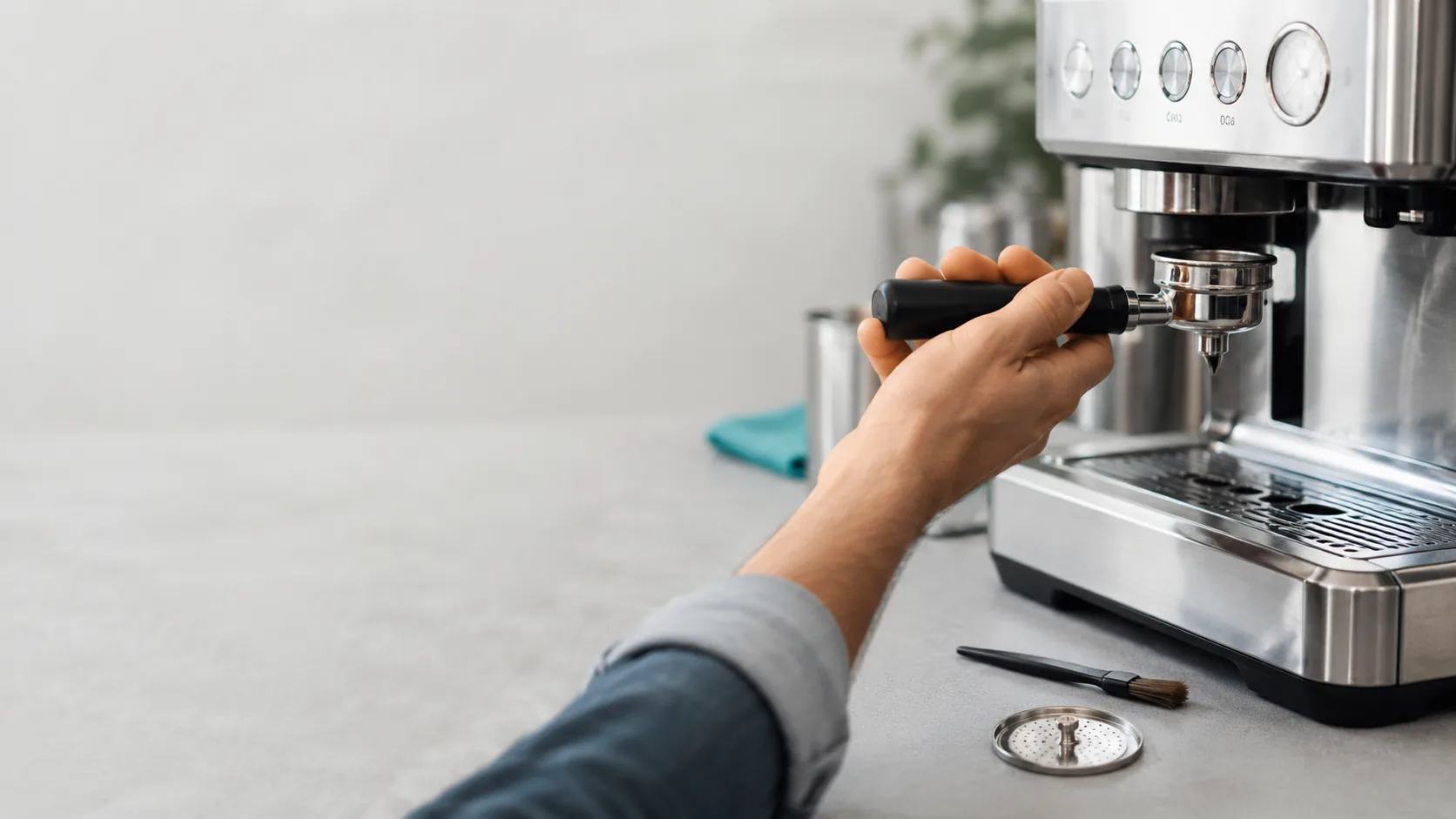
If your Barista Express is hissing away, the gauge needle is barely twitching off the peg, and what lands in the cup is a sad, pale trickle — take a breath. In the overwhelming majority of cases the pump and the machine are completely fine. The problem is almost always in the four inches between the grinder and the cup: the grind, the dose, the basket, or a screen that hasn’t been cleaned in a while.
I’ve had my BES870 since 2019, and I’ve walked dozens of people through this exact panic. We’re going to do two things: first, read the pressure gauge properly so you know which direction the problem is (most guides skip this and it’s the whole game), then go cause by cause, most common first, until your shots are back in the zone.
First, read the gauge — it’s telling you what’s wrong
The gauge on the front isn’t decoration, and it isn’t really measuring the pump. It’s measuring the resistance your coffee puck puts up. That distinction is the key to this whole article.
- Needle barely moves, shot pours fast and pale: water is finding too little resistance — too coarse, too little coffee, or it’s running around the puck. This is by far the most common “no pressure” complaint.
- Needle pegs hard into the high zone and almost nothing comes out: the opposite problem — too fine or too much coffee. People read this as “no pressure” because no espresso appears, but it’s too much resistance.
- Needle sits in the espresso range but the cup still tastes weak: usually a basket or extraction issue, not pressure at all.
Pull one shot and watch the needle. Whichever you see tells you which sections below to read first. Don’t skip this — I’ve watched people “fix” a choking machine by grinding even finer and make it worse.
Cause 1 — Grind too coarse or dose too low (the usual culprit)
What it looks like: Needle stays low, shot gushes out in 5–10 seconds, thin and blonde, little crema.
Why it happens: Espresso lives on resistance. If the grounds are too coarse, water sprints through the gaps instead of being forced through the bed. The Barista Express grind dial runs from coarse (16) to fine (1), and there’s a second, internal burr adjustment most people never touch. For most fresh beans you want roughly 5–8 on the dial — but the number matters far less than the result in the cup.
How to confirm: Time the shot. A double should take roughly 25–30 seconds to pull about 2 oz (60 ml). If you hit 2 oz in 12 seconds, you’re too coarse, full stop.
The fix:
- Move the grind dial two steps finer (toward 1).
- Actually fill the basket. After grinding, tap the portafilter, top it level, and use the Razor dose trimming tool that came in the box to trim the excess. That’s your correct dose.
- Tamp level with firm, even pressure — you’re flattening the bed, not crushing it.
- Pull again and time it. Adjust grind one step at a time until you land in the 25–30 second window.
Cause 2 — You’re fighting the wrong basket (single vs dual-wall)
This trips up almost every new owner, so it earns its own section. The Barista Express ships with four baskets: single-wall (1 and 2 cup) and dual-wall / “pressurised” (1 and 2 cup). They look near-identical from the top — flip them over. The dual-wall baskets have one tiny pinhole in a second floor underneath; the single-wall have an open mesh of holes.
- Dual-wall baskets create their own back-pressure through that pinhole. They’re forgiving and make crema even with supermarket pre-ground. If you’re using these and getting no pressure, that pinhole is usually clogged (see Cause 5) or the coffee is stale.
- Single-wall baskets give zero help. They demand a correct, fine grind and a proper dose. Coarse coffee in a single-wall basket gives exactly the weak, gushing shot people describe as “no pressure.”
The fix: Work out which basket is in your portafilter. If you’re still dialling in your grinder, start with the dual-wall baskets — they remove three variables at once. Move to single-wall when your grind is consistent.
Cause 3 — Stale, oily, or pre-ground beans
Coffee degasses as it ages. Fresh beans (roasted within ~2–4 weeks) hold the CO₂ that builds crema and resistance; beans open on the counter for two months simply can’t build a proper shot. Look at the bloom: fresh coffee swells during pre-infusion, stale grounds just sit there. Use whole beans, roasted recently, ground right before you pull. If you’ve been running pre-ground in a single-wall basket, that combination alone explains the weak shot.
Cause 4 — Channeling (water punching through the puck)
What it looks like: Needle wobbles low, the shot sprays unevenly or squirts from one side.
Why it happens: If the puck isn’t level before tamping, water carves the path of least resistance straight through and never pressurises the bed. You can have a perfect grind and still get a weak shot from a lopsided puck.
The fix: Distribute the grounds level, then tamp dead flat. Don’t bang the portafilter on the counter after tamping — that cracks the puck and causes the exact channeling you’re avoiding. One calm, level press.
Cause 5 — Clogged shower screen, group head, or basket holes
This is the big one if your machine used to pull great and slowly got worse.
Why it happens: Coffee oils and fines bake onto the shower screen and into the tiny basket holes over months. Flow drops, pressure gets erratic, shots turn bitter. On a dual-wall basket, that single pinhole clogging is enough to kill pressure entirely.
How to confirm: Is the CLEAN ME light flashing? The Barista Express asks for a clean roughly every 200 shots. Even if it isn’t, run a finger across the shower screen — gritty or oily means it’s overdue.
The fix:
- Run the clean cycle: drop a Breville cleaning tablet into the grey silicone cleaning disc, put it in the 1-cup dual-wall basket, lock in the portafilter, and run the cycle per the manual.
- Soak the baskets and portafilter in hot water with a cleaning tablet (or Cafiza) for 20–30 minutes, then scrub the holes with a soft brush.
- Wipe the shower screen; if yours unscrews, remove and soak it too.
Cause 6 — Scale build-up (hard-water machines especially)
Limescale narrows the internal water paths and coats the heating system, choking flow and pressure. If you’re in a hard-water area and have never descaled, this is a prime suspect — and it will eventually kill the machine. Run a full descale with Breville’s descaler (or a quality espresso-machine descaler) following the manual, then fit and set the water filter in the tank to slow it coming back.
Cause 7 — Grinder not actually grinding finer
Sometimes you turn the dial finer and nothing changes — because the top burr isn’t seated after cleaning, it’s set to the wrong position, or the burrs are worn after years of use. Grind into the portafilter and look: the grounds should feel like fine sand, not table salt. If the finest setting still feels gritty, open the hopper, remove and reseat the top burr (check the alignment markings), and make sure it clicks home. Burrs worn out after years of daily use are an inexpensive part and a 15-minute swap.
Cause 8 — The pump or OPV (rare — check this last)
I’m putting this last on purpose, because it’s where panicked owners start and it’s almost never the answer. If — and only if — you have a fresh fine grind, a correct dose, a spotless single-wall basket, a descaled machine, and the gauge still won’t climb, you may have a genuinely weak pump or an over-pressure-valve issue. A failing pump usually changes its sound to a harsher, straining whine and pushes noticeably less water. That’s the one repair here that may need a tech or a vibration-pump replacement.
Repair or replace? The honest maths
The Barista Express is worth keeping alive — it’s well built and parts are available.
- Cleaning, descaling, baskets, gaskets, even burrs: always worth it. $10–40 in parts to restore a ~$700 machine.
- A new vibration pump or solenoid: parts are modest (~$30–60) but fiddly — worth it if you’re handy or have a fair-priced local tech.
- A dead control board out of warranty with a quote past ~$200, on a 7+ year old machine: that’s where I’d price a replacement instead. The repair is half the cost of new.
If it’s still under Breville’s warranty, stop here and contact them before doing anything beyond cleaning.
Stop it happening again (2 minutes a week)
- Flush water through the group head before and after each session.
- Wipe and purge the steam wand every time.
- Backflush with the cleaning disc and tablet when the CLEAN ME light asks.
- Descale on schedule for your water hardness, and keep a fresh filter in the tank.
- Soak your baskets monthly — those pinholes clog quietly.
A Barista Express that’s cleaned and descaled on schedule holds pressure for a decade. The ones that “die” almost always died of neglect, not age.
Free: the Espresso Fix-It Cheat Sheet (PDF)
The 1-page printable that takes any fault to its cause, plus the maintenance schedule that prevents most breakdowns. Straight to your inbox.
By subscribing you agree to receive emails from BaristaFix and to our Privacy Policy. No spam — unsubscribe anytime.Frequently asked questions
Why is my Barista Express pressure gauge not moving at all?
Why does the gauge max out but no espresso comes out?
My shots got weak after two years — what changed?
Do the dual-wall baskets cause low pressure?
Marco spent twelve years servicing espresso machines — first behind the bench at a specialty café group, then running his own repair workshop. He has stripped down, fixed and reassembled everything from a battered Gaggia Classic to high-end Swiss automatics. He writes the fixes here only after reproducing the fault on a real machine, and he'll always tell you when a repair isn't worth the money.