
Breville Bambino Plus Flashing Lights? What Every Button Pattern Means
 By Marco R. · Lead repair technician Updated June 18, 2026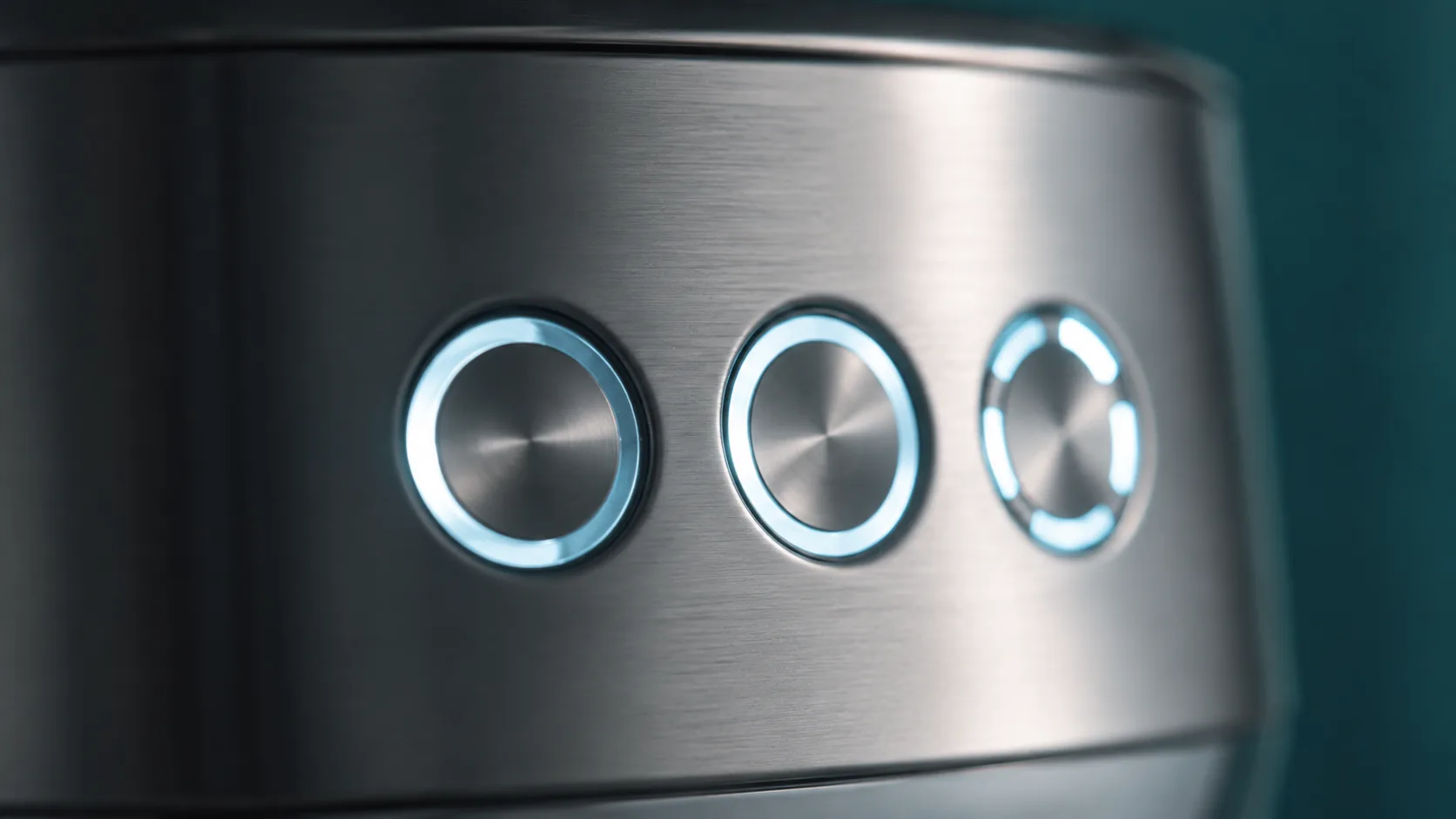
The Bambino Plus has no display — just a handful of backlit buttons — so it tells you everything through how those lights behave. That’s elegant when you can read it and baffling when you can’t. The good news: there are only a few patterns to learn, and most of them aren’t faults at all. A flash on start-up is just the machine heating. The trick is knowing which patterns are normal, which mean “do some maintenance,” and which mean “something’s actually wrong.”
Let’s decode the light language, then fix the two patterns that actually need action: the descale alert and the all-buttons-flashing fault.
The light language at a glance
| Pattern | What it means | What to do |
|---|---|---|
| 1-cup & 2-cup flash on start-up, then solid | Normal ThermoJet heating | Wait a few seconds — it’s ready when solid |
| Steam light flashing | Heating to steam temp / milk cycle | Wait for it to settle, then steam |
| A cup button flashing while brewing | Shot-volume programming mode | Set the volume, or power-cycle to exit |
| Descale alert illuminated | Descaling is due | Run the descale cycle (below) |
| All buttons flashing continuously, no heat | Fault state | Power-cycle, check water, let it cool |
Normal pattern 1 — Flashing on start-up (just heating)
What it looks like: You switch on and the 1-cup and 2-cup buttons flash for a few seconds, then turn solid.
Why it happens: The ThermoJet heats water almost instantly, and the flashing simply shows it’s coming up to brew temperature. Solid lights mean ready.
What to do: Nothing — this is the machine working as designed. Wait for the lights to go solid (usually just a few seconds) and brew.
Normal pattern 2 — Steam light flashing
What it looks like: After selecting steam, the steam light flashes before steam is available.
Why it happens: It’s heating to the higher steam temperature, or running the automatic milk cycle.
What to do: Wait for it to settle. If it flashes but never produces steam even after priming and descaling, that’s a heating issue, not normal behaviour — see the steam wand guide.
Normal pattern 3 — A cup button flashing while you brew
What it looks like: The 1-cup or 2-cup button flashes during a shot.
Why it happens: You’re in volume-programming mode — the machine is learning how much to pour.
What to do: To set a volume, press and hold the cup button through the shot and release when you reach the amount you want; it flashes to confirm. To exit without changing anything, power-cycle the machine.
Action needed 1 — The descale alert
What it looks like: A descale indicator illuminates to tell you mineral build-up is due for removal.
Why it happens: The machine tracks usage and water, and limescale steadily narrows the ThermoJet. Descaling on time protects flow, steam pressure and the machine’s lifespan.
How to descale:
- Empty the drip tray and refit it, and remove the water filter from the tank.
- Fill the tank with descaling solution and water per the descaler’s instructions.
- Enter descale mode — on most units, with the machine off, press and hold the 1-cup, 2-cup and steam buttons together for a few seconds until they flash (check your manual; the exact combination can vary).
- Run the solution through the group, and through the hot-water/steam outlet, as directed.
- Rinse thoroughly — run two or three full tanks of fresh water through before making coffee again.
Action needed 2 — All buttons flashing, machine won’t heat (fault state)
What it looks like: Every button flashes continuously and the machine never reaches temperature or brews.
Why it happens: This is the Bambino’s general fault signal. The most common triggers are:
- The tank ran dry — the ThermoJet protecting itself from heating with no water.
- Overheating after lots of back-to-back shots or steaming.
- A transient glitch that just needs resetting.
The fix:
- Turn it off at the wall and unplug it for about 60 seconds.
- Make sure the tank is filled and firmly seated — never run it dry.
- If it’s been working hard, let it cool for 20–30 minutes before restarting.
- Power back on and watch the start-up sequence.
A power-cycle clears the great majority of these. If it heats and behaves normally afterwards, you’re done.
If the fault won’t clear
What it looks like: The buttons keep flashing and the machine won’t heat even after a power-cycle, water and a cool-down.
Why it happens: A persistent fault after the basics points to a heating or electronics issue rather than something you can clear at the counter.
The fix: Don’t keep cycling it on and off repeatedly. If you’re in warranty, contact Breville support — this is exactly what it covers. Out of warranty, a Breville service centre can diagnose the ThermoJet and control board. There’s nothing user-serviceable inside, so this is the one error pattern that genuinely needs the professionals.
Common mistakes that make it worse
- Treating the normal start-up flash as a fault and unplugging mid-heat every time.
- Restarting a dry machine without filling the tank, so the fault returns instantly.
- Ignoring the descale alert until flow and steam fade.
- Rinsing too little after descaling, leaving a chemical taste — run several tanks of fresh water.
- Repeatedly power-cycling a genuine fault instead of contacting Breville.
Repair or replace?
Almost every “error light” on a Bambino Plus is either normal behaviour, a descale reminder, or a fault that a power-cycle and a full tank clear — all free. The only replace-or-service scenario is a fault that survives the reset, water and cool-down, and even then warranty or a service centre is the route, not a new machine. Learn the five patterns above and the Bambino stops being mysterious.
Stop it happening again
- Learn the normal start-up flash so you don’t mistake it for an error.
- Never run the tank dry, and prime after every refill.
- Run the descale cycle as soon as the alert appears, and rinse well afterwards.
- Give the machine a moment to cool during long milk-and-shot sessions.
- Keep descaling solution and a spare filter on hand so maintenance is never a reason to delay.
Free: the Espresso Fix-It Cheat Sheet (PDF)
The 1-page printable that takes any fault to its cause, plus the maintenance schedule that prevents most breakdowns. Straight to your inbox.
By subscribing you agree to receive emails from BaristaFix and to our Privacy Policy. No spam — unsubscribe anytime.Frequently asked questions
What do the flashing lights on my Breville Bambino Plus mean?
Why are all the buttons flashing on my Bambino Plus and it won't heat up?
How do I descale my Breville Bambino Plus?
How do I reset my Breville Bambino Plus?
Why is the steam light flashing on my Bambino Plus?
The buttons flash when I turn it on, then it works — is that normal?
How do I change or reset the shot volume on my Bambino Plus?
Marco spent twelve years servicing espresso machines — first behind the bench at a specialty café group, then running his own repair workshop. He has stripped down, fixed and reassembled everything from a battered Gaggia Classic to high-end Swiss automatics. He writes the fixes here only after reproducing the fault on a real machine, and he'll always tell you when a repair isn't worth the money.