
Espresso Machine Keeps Tripping the Breaker? Causes and What's Safe to Do
 By Marco R. · Lead repair technician Updated July 2, 2026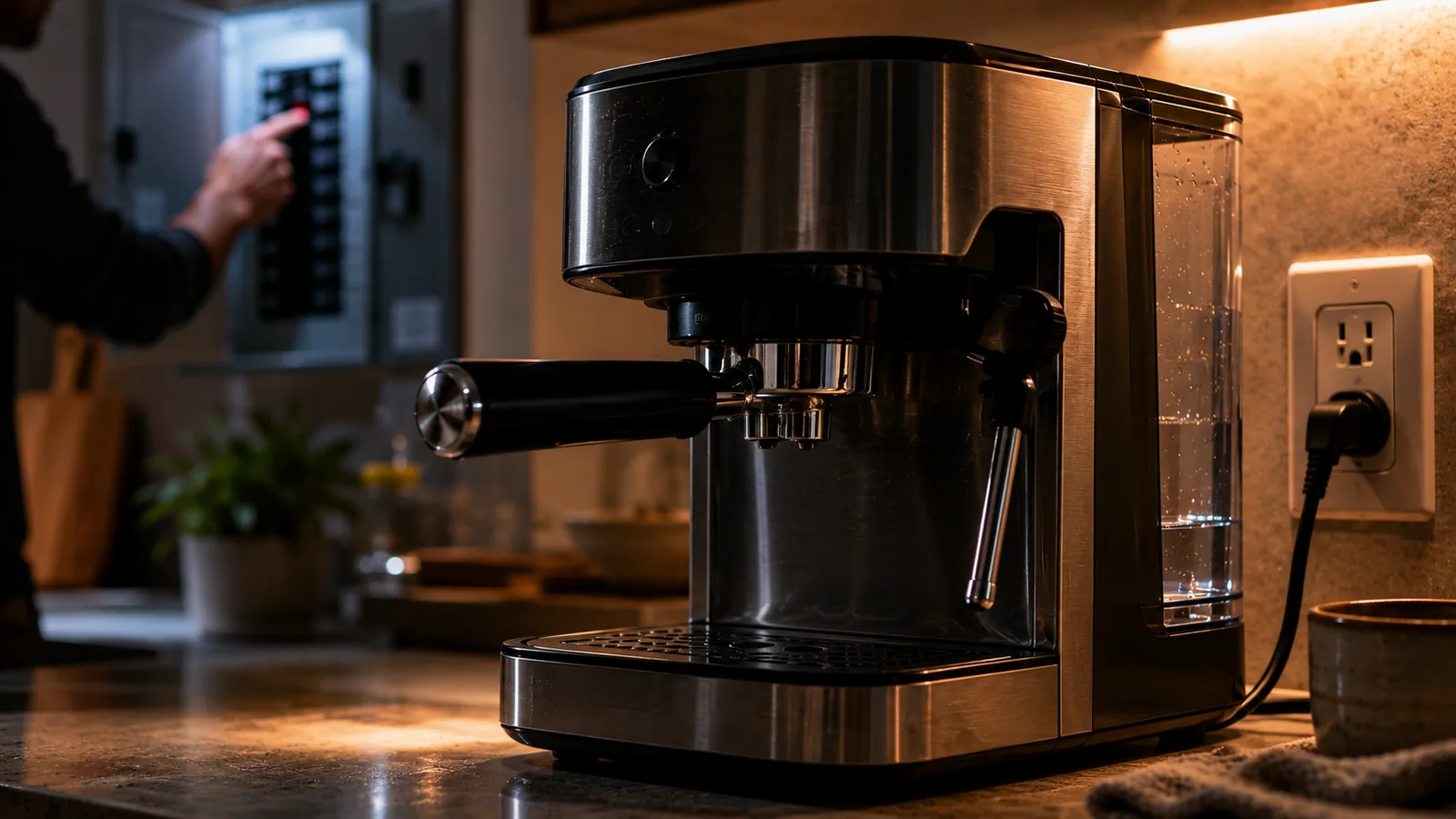
An espresso machine that trips the breaker or the RCD is one of the few faults where the right first move is to slow down rather than start fiddling. The reason is simple: two completely different problems produce the same symptom, and one is a harmless wiring inconvenience while the other is a genuine electrical fault you shouldn’t keep running. The good news is you can tell them apart with a few careful observations — no tools, no opening the machine. This guide shows you how, and is clear about where the fix stops and a professional starts.
Step one: what kind of trip is it?
Before causes, identify the pattern. It usually falls into one of these:
- Trips only when other appliances run too (kettle, toaster, microwave, heater) → overload of a shared circuit. Common and fixable.
- Trips on its own, with just the espresso machine plugged in → a fault in the machine. Serious; needs inspection.
- Trips specifically as it heats up → strongly suggests a heating element leaking to earth.
- Trips the moment you plug it in or switch on → a dead short, often a damaged cord or a failed component.
- Trips and the machine is also leaking water → water has likely reached live parts.
Whether it’s the ordinary breaker or the RCD/GFCI matters: the RCD catches current leaking to earth (a shock hazard), so an RCD trip points much more firmly at a real fault than an overload.
The harmless cause: circuit overload
What it looks like: the machine is fine alone, but the breaker trips when you also run the kettle, toaster, air fryer or another heater on the same circuit. Why: espresso machines pull a large current while heating — often 1000–1500 W. Add another high-draw appliance on the same circuit and the total exceeds what the breaker allows. How to confirm: unplug everything else on that circuit and run the machine alone. If it stops tripping, it was overload. Fix: put the machine on an outlet that’s on a different circuit from other big appliances, and avoid running them simultaneously. This is a usage/wiring fix, not a machine fault — the machine is healthy.
The serious causes: a fault in the machine
If the machine trips on its own, the problem is inside it. These are not DIY repairs on most home machines, and several are shock hazards — the aim here is to diagnose enough to know it needs a technician (or replacing), not to open it up.
Heating element leaking to earth
What it looks like: trips the RCD, often right as it starts heating. Why: heat and moisture can crack a heating element or break down its insulation, so current leaks to earth as it energises. The RCD catches exactly this. What to do: stop using it. On a quality machine a technician can test and replace the element; on a cheap machine, replacement of the machine is usually the sensible call.
Water reaching live parts
What it looks like: the machine both leaks and trips. Why: a cracked tank, a split internal hose or heavy condensation can bridge water to electrical components. What to do: unplug, dry it out fully, and check the tank and seals (see leaking water). If it still trips when completely dry, the fault is electrical — get it inspected.
Damaged power cord or plug
What it looks like: trips instantly on plug-in or switch-on; the cord may be frayed, kinked or scorched, or show damage near the plug. Why: a damaged cord can short live to earth. What to do: stop using it. A frayed or scorched cord is a fire and shock risk; have the cord replaced by a competent person or replace the machine.
A failed internal component
What it looks like: trips on power-up with no obvious cord damage. Why: a shorted pump, switch or thermal component. What to do: this needs a technician’s meter to find; it’s beyond safe DIY.
Common mistakes
- Repeatedly resetting the breaker and carrying on — this defeats a safety device.
- Assuming it’s the machine when it’s really an overloaded shared circuit (check that first — it’s free).
- Ignoring an RCD trip as if it were the same as a normal breaker trip — it isn’t; it signals leakage to earth.
- Running a machine that trips and leaks — unplug it.
- Opening the machine to “check the element” — heating circuits are mains-live and not a DIY area.
Repair or replace?
If it’s overload, there’s nothing to repair — reorganise which outlet the machine uses and you’re done. If it’s a genuine internal fault, the decision is about value: a heating element or cord replacement can be worth it on a mid- or high-end machine through a qualified technician, but on an inexpensive machine the safe and economical choice is usually to replace it. Either way, the machine should not go back into use until the fault is found and fixed — a machine that trips the electrics is not a machine to nurse along.
Stop it happening again
Give the machine its own outlet on a circuit that isn’t shared with the kettle and toaster, keep water away from the base and cord, and deal with leaks promptly so moisture never reaches electrical parts. Keep up with routine upkeep and don’t ignore small warning signs — a machine that has started to occasionally flick the breaker as it heats is telling you early. Treat the electrics with respect and you’ll catch the difference between “too much on one circuit” and “time to retire this machine” before it becomes a hazard.
Free: the Espresso Fix-It Cheat Sheet (PDF)
The 1-page printable that takes any fault to its cause, plus the maintenance schedule that prevents most breakdowns. Straight to your inbox.
By subscribing you agree to receive emails from BaristaFix and to our Privacy Policy. No spam — unsubscribe anytime.Frequently asked questions
Why does my espresso machine keep tripping the breaker?
Is it dangerous if my coffee machine trips the electrics?
What's the difference between the breaker and the RCD tripping?
My espresso machine trips the switch as soon as it heats up — why?
Can I just move my espresso machine to a different socket?
Could water be causing my espresso machine to trip the power?
Is it ever safe to keep resetting the breaker and carry on?
Marco spent twelve years servicing espresso machines — first behind the bench at a specialty café group, then running his own repair workshop. He has stripped down, fixed and reassembled everything from a battered Gaggia Classic to high-end Swiss automatics. He writes the fixes here only after reproducing the fault on a real machine, and he'll always tell you when a repair isn't worth the money.