
Espresso Only Dripping, Not Pouring? Why It Chokes and How to Fix It
 By Marco R. · Lead repair technician Updated July 2, 2026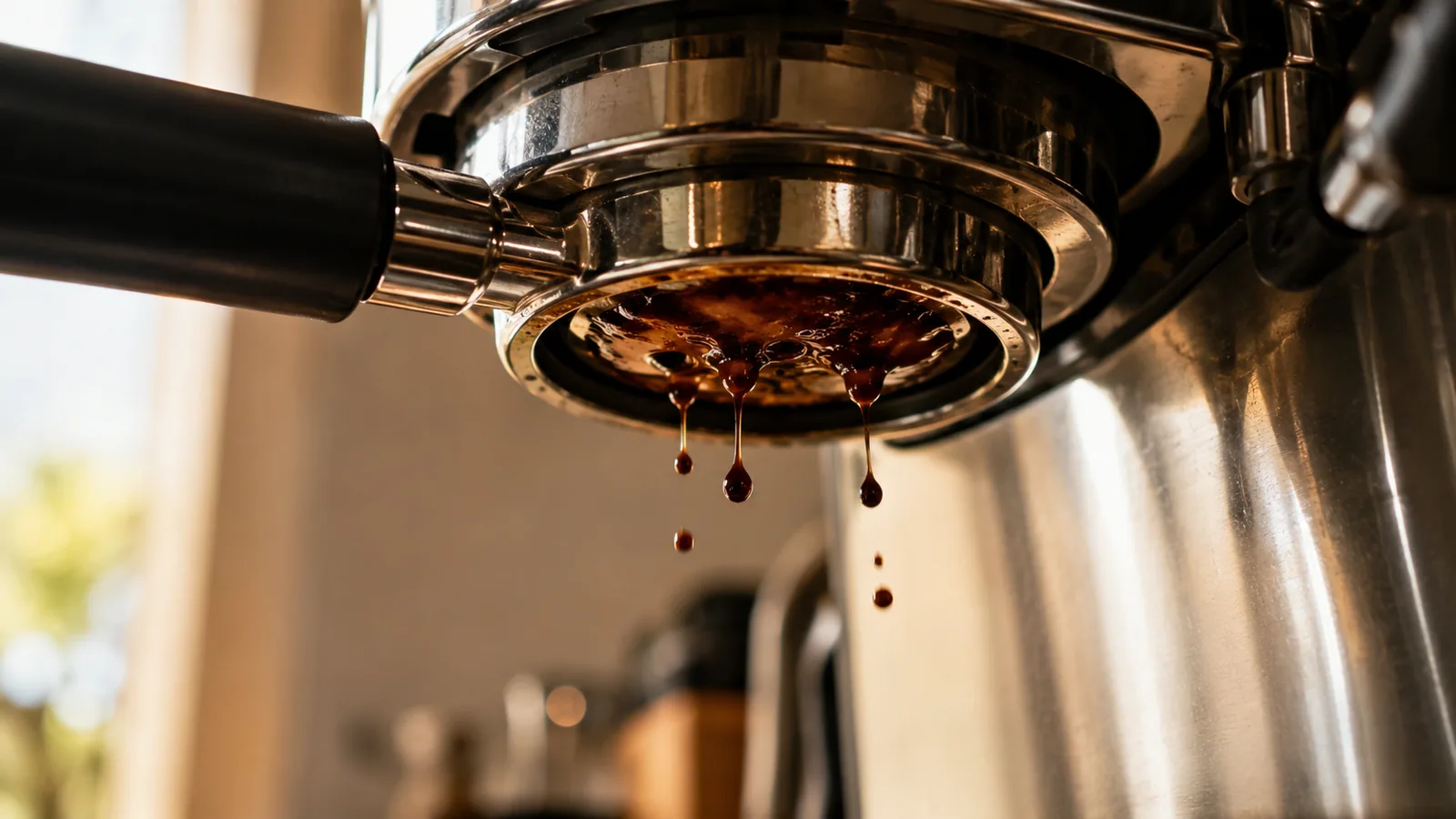
A shot that refuses to pour — a slow, stubborn drip, a few dark drops, and not much else — feels like the machine has given up. It usually hasn’t. A drip is the exact opposite of a weak, gushing shot: instead of too little resistance, the water is meeting too much, and it can’t get through the coffee. That’s good news, because almost every cause lives in front of the machine — the grind, the dose, or a puck path that needs cleaning — and it’s fixable in minutes, for free. This guide covers every cause across manual, bean-to-cup and pod machines, then sends you to the exact steps for your model.
First, read the pour
Three very different faults all get described as “my espresso isn’t working.” Tell them apart before you touch anything, because the fixes point in opposite directions:
- Only dripping / choking — the pump strains, barely anything comes out, and on gauge machines the needle pins high. That’s too much resistance. This guide.
- Nothing at all, pump whining or surging — often an air-lock or an empty/misseated tank, not the coffee. See not pumping water.
- Fast, pale, crema-thin — too little resistance. That’s the reverse; see no pressure / weak shots.
Get this right first. Grinding finer to “help” a choke, or coarser to “help” a gusher, is the single most common way people make things worse.
The causes on a portafilter machine
1. Grind too fine — the number-one cause
What it looks like: the pump loads up, pressure climbs, and you get a dark, slow drip that may never build into a stream. Why: finer coffee packs tighter and leaves the water almost no path through the puck. How to confirm: back the grinder off two or three steps and pull again. If flow returns, that was it. Fix: grind coarser until a double pours in roughly 25–30 seconds. Change one grind step at a time and re-time each shot.
2. Too much coffee in the basket (over-dosing)
What it looks like: choking that grinding coarser doesn’t fully cure, sometimes with a smeared, screen-marked puck. Why: an overfilled basket leaves no headroom, so the wet puck swells into the shower screen and seals off flow. How to confirm: lock the empty portafilter in, then remove it — if the screen has left a deep imprint in a fresh puck, you’re too high. Fix: dose so the tamped puck sits a few millimetres below the rim. Weighing the dose (a scale is the cheapest upgrade in espresso) removes the guesswork.
3. Clogged shower screen
What it looks like: a machine that used to pour fine now chokes or drips unevenly, often to one side. Why: coffee oils bake onto the screen and slowly throttle and unbalance the water coming into the puck. How to confirm: run a blank shot with no coffee — if water sprays sideways or dribbles unevenly from the group, the screen is dirty. Fix: wipe the screen after use, backflush machines that allow it, and unscrew and soak the screen in a coffee detergent periodically.
4. Clogged or scaled basket holes
What it looks like: patchy, one-sided dripping even with a clean screen and a sensible grind. Why: the fine laser-drilled holes in a single-wall basket clog with oils and limescale. How to confirm: hold the empty basket up to a light — blocked holes show as dark spots — or run water through it alone. Fix: soak the basket in coffee detergent; for scale, a descaling soak. If holes stay blocked, baskets are cheap to replace.
5. Blocked pressurised-basket valve
What it looks like: a machine that came with a “dual wall” basket suddenly chokes. Why: pressurised baskets meter flow through a single tiny hole or valve, which clogs completely with grounds or oils. How to confirm: remove the basket and check the valve/hole underneath for a plug of coffee. Fix: clear and soak it. These baskets are meant to forgive a coarse grind, so if it’s blocking often, clean more regularly.
6. Oily, dark-roast or very fresh beans
What it looks like: the same grind that worked last week now chokes on a new bag. Why: oily dark roasts and very freshly roasted beans behave differently — more fines, more gas, more clogging. How to confirm: it lines up with opening a new bag or switching roast. Fix: coarsen a step or two for oily beans, and give very fresh beans a few days to de-gas.
7. Limescale in the waterways
What it looks like: flow that has slowly dropped off over months in a hard-water area, often with a descale warning. Why: scale narrows the internal pipes and group, throttling everything. How to confirm: it’s gradual, not sudden, and you’re overdue a descale. Fix: run a full descale, then re-check.
Bean-to-cup automatics
Automatics grind, dose and tamp for you, so a weak dribble points at their own parts, not your technique:
- Brew unit needs cleaning — the mesh and piston clog with oils. Remove and rinse it if your model has a removable unit; run a brew-unit cleaning tablet otherwise.
- Grind setting too fine — most machines have a grind dial; nudge it one step coarser (adjust it while the grinder is running).
- Wet, mushy pucks — firm, damp pucks are healthy; sodden ones mean grind and brew-unit cleanliness. Philips owners searching for a machine that isn’t forming a proper puck are usually here — clean the brew unit and coarsen a step.
Pod machines
On a Nespresso or other capsule brewer, a drip is almost never about grind:
- Blocked piercing needles or plate — old grounds and scale clog the spikes that pierce and drain the capsule.
- Clogged spout or head — coffee residue builds up where the drink exits.
- A capsule seated wrong or a mismatched pod.
Run a descale plus a no-capsule hot-water flush, and clean the head and spout. If your Vertuo drips or stalls, see Vertuo not making a full cup.
Common mistakes
- Tamping harder to force it through — this adds resistance to a shot that already has too much.
- Chasing grind while the screen and basket are filthy — clean first, then dial.
- Grinding finer AND over-dosing, then blaming the pump.
- Never backflushing a machine that supports it, so oils quietly strangle flow.
- Running oily dark roast at an espresso-fine setting meant for medium beans.
Repair or replace?
This is one of the cheapest faults there is. The overwhelming majority of choking shots are fixed with a grind adjustment, a lighter dose, and a clean screen and basket — no parts, no cost. Genuine hardware causes (a stuck-shut over-pressure valve, a failing pump) are rare and come last, only after grind, dose and cleaning are ruled out. Before you spend anything, work through the list above.
Stop it happening again
Dial the grind and weigh the dose for a steady 25–30 second double, keep the shower screen and basket clean, backflush or clean the group on schedule, and descale before scale can throttle flow. Store beans well and coarsen slightly for oily roasts. Once you understand the one lever that matters most — grind size — a choking shot becomes a two-minute fix rather than a mystery.
Free: the Espresso Fix-It Cheat Sheet (PDF)
The 1-page printable that takes any fault to its cause, plus the maintenance schedule that prevents most breakdowns. Straight to your inbox.
By subscribing you agree to receive emails from BaristaFix and to our Privacy Policy. No spam — unsubscribe anytime.Frequently asked questions
Why is my espresso only dripping and not pouring?
Is a dripping espresso the same as no pressure?
My espresso suddenly started only dripping — what changed?
Can tamping too hard make espresso choke?
Why does my bean-to-cup machine only dribble coffee?
Will descaling fix an espresso machine that only drips?
How fine is too fine for espresso?
Marco spent twelve years servicing espresso machines — first behind the bench at a specialty café group, then running his own repair workshop. He has stripped down, fixed and reassembled everything from a battered Gaggia Classic to high-end Swiss automatics. He writes the fixes here only after reproducing the fault on a real machine, and he'll always tell you when a repair isn't worth the money.